 Analyses of all verses
|
 Web Site
 |
 All
Sefirots All
Sefirots |
NOSTRADAMUS and Leonardo Da Vinci
© Allan Webber Aug 2022, Dec 2025CE
See the following paper for the Rationale & Rules underlying my work on Nostradamus. |
This site shows how people such as Da Vinci, Montorfano, Cornelius Agrippa, Esclarmonde, Marguerite Angouleme and Bellaso are essential to understanding many of Nostradamus' verses.
Much of the content in this page emerged in the 2nd quarter of 2022 when I turned my research to coding threads in verses that stand apart from from the mainstream stories about our times.

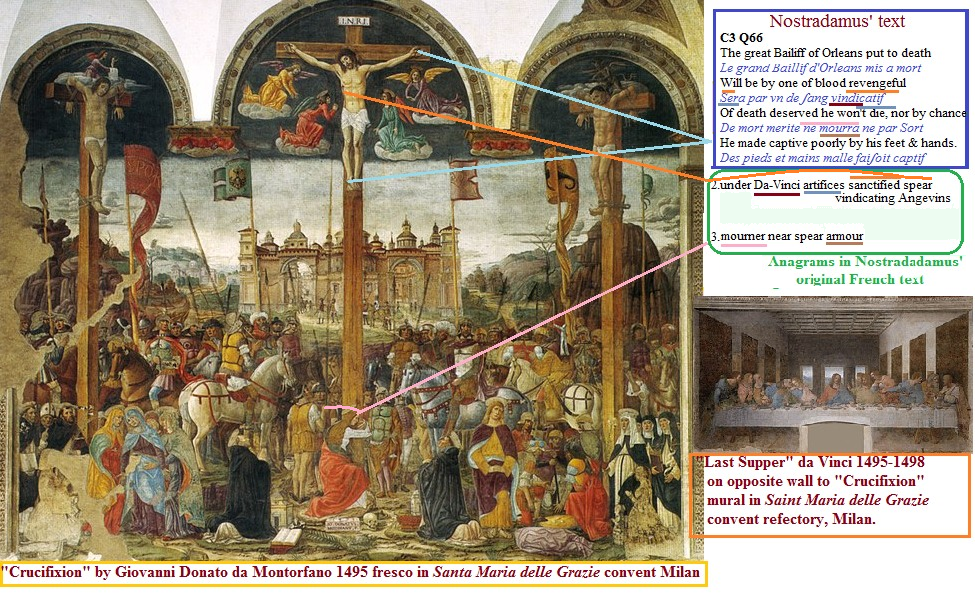
In the above image of the verse showing
the text in English plus the original French
(in italics) and
alongside (to the right) are some of the English anagrams found in
the verse's text it is immediately apparent
that the complex anagrams for masonism,
immortals etc can stimulate word pictures.
Of course their being found in English
is disturbing for many readers. However such
difficulties are not unexpected given the
purpose of the prophecies, as claimed by
Nostradamus, is to act as a secret reservoir. I
believe these hurdles are surmountable if the
quality and usage of the anagrams and text is disciplined.
In this instance the wording of the text
hints at the 'demise of Christ' story.
Important aspects in this verse are able to
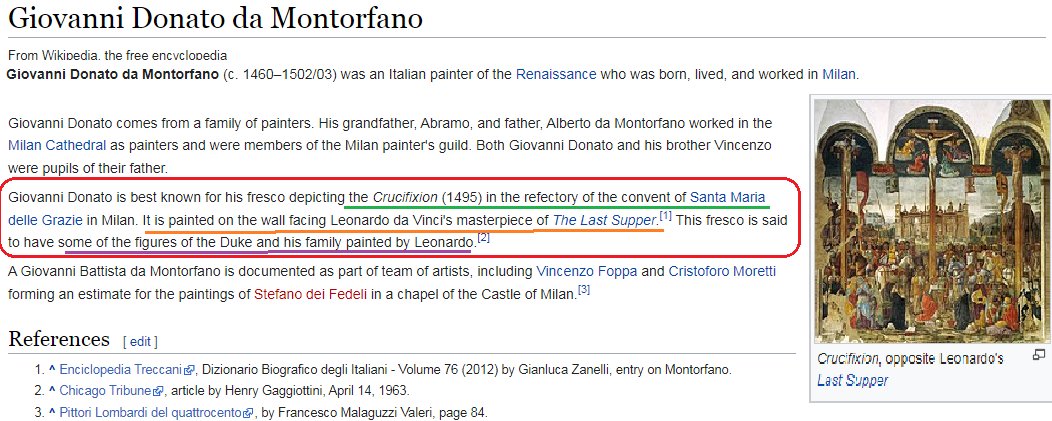
be found in the Montorfano' fresco painted
in 1495. The unusual bonds of the feet and
hands in the fourth line 4 gives one such
hint while the third and fourth line of the text of
Nostradamus' verse embraces the unique
nature of the death given in the Christ
story.
C3 Q66
The great Bailiff of Orleans put to death
Will be by one of blood revengeful
Of death deserved he will not die, nor by
chance
He made captive poorly by his feet and
hands.
And the anagrams for sanctified spear,
mourners and armor nearby also reflect the
vital action occurring in the Christ' death
story.
Now da Vinci painted his famous Last Supper on the opposite wall to that of Montorfano's Crucifixion in the convent in Milan called 'Holy Mary of Grace' in the years 1495 to 1498. So the artist for the above artworks overlapped with da Vinci. Notably, Leonardo is known to have had a small part in the painting of figures shown in the ' Crucifixion'. This possibility, (that Da Vinci's influence in these art works is mentioned in the aforementioned verse from Nostradamus' Prophecies), is shown below. The image below uses colored lines to link the references in Nostradamus verse to aspects in Montorfano's artwork.
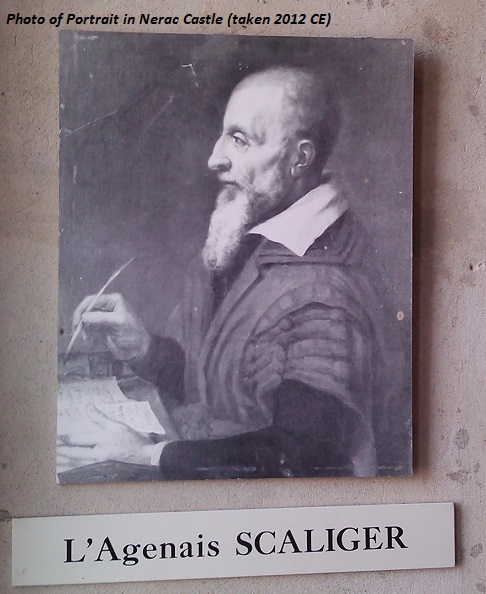
There is still physical evidence at Marguerite's court at Nerac located very close to Agen, that Scaliger was appointed to service the medical needs of that court in the 1540's. This liaison meant a substantive link existed between the heads of these neignbouring power centers. And Nostradamus was therefore part of the events unfolding in France in that peried.
Hence the verse and the hidden story involvimg Leonardo holds together thereby indicating the high interest in code techniques in the 16thC may play an important role in understanding Nostradamus' code.
This interest is shown through C10 Q18 and C3 Q21 which are the only two verses where an anagram for Esclarmonde is found.
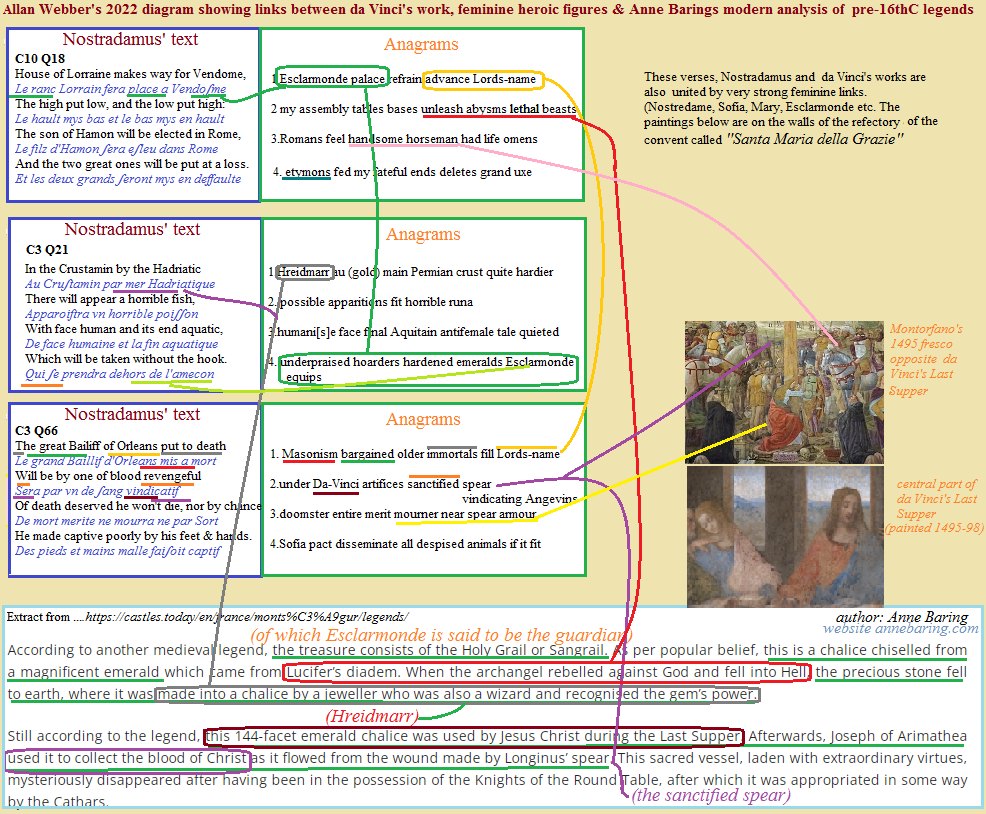
These are also tied to verse C3 Q66 through anagrams for Lords-name and a story line that ties them to the da-Vinci links found in C3 Q66.Other anagrams that appear in the current post's two verses and nowhere else include etymons, Hriedmar, handsome and horseman. Etymons alludes to the origin and history of words.
The gemstone emerald also found here plays a significant role in the story of Hriedmarr who was the master craftsman of gemstones.
He appears in the Nordic mystic tales where he is a dwarf who gathers, shapes and hoards emeralds and gold.
Among the many aspects for which Eleanor of Aquitaine was famous was her magnificent ring holding a giant perfect emerald. The mystical part of the story of Esclarmonde includes her being the final keeper of the Cathar treasures with emeralds being a prominent part. Legend has it Esclarmonde was the guardian of an emerald chalice created by a master craftsmen that was used to catch Jesus blood.
The Nordic tales are of the 1st millennium, Eleanor lived in the early 12th century while Esclarmonde was born three decades later. Marguerite d'Angouleme and these two heroically strong women from her past reflected the culture and ethos of Southern France that undoubtedly influenced Nostradamus' life and motivations.
With his name of Nostredame meaning 'our lady', this Southern France culture undoubtedly felt personal to him. The cult of Mary has been and still is common throughout that region. The material attached to this page shows there is material in these verses (linked by terms about the power of words) that have great cohesion. The extent of this cohesion makes it nigh impossible to explain their sensible appearance together as a product of chance.
This evidence I produce of links in the verses of Nostradamus implies he played the main role in their patterned existence in his Prophecies. His using such relevant legends only reflects on his methods and motivations without vindicating or disproving the truth of the legends. However being present in such a substantial manner they do suggest they have more relevance to our time, since even Marguerite d'Angouleme was dead when his prophecies were first published.
This aspect is bolstered by their existence as English anagrams although many of the anagrams such as Esclarmonde, Hriedmar, emeralds and sanctified take same or very similar form in many languages. Notably a great number aren't. I commend anyone interested in this topic to read the articles by Anne Baring on her website and in particular the one titled " Esclarmonde de Foix, Cathar Parfaite"
So much of the material that I have presented over the last twenty years mirrors that given in Baring's scholarly presentation of the history of the female spirit in southern France.
Now what unites these verses in an evidential manner is their relationship to code techniques. A similar hint of the nature of da Vinci's code lies in Dan Brown's story which highlights clues left in pictures that mean more to the initiated than the common viewer.
In the case of Esclarmonde it lies in the way the Cathar central message survived the destruction of Montsegur and the genocide of the sects followers; legend has it that one way their doctrine persisted was because the water marks in the fabric of their most sacred documents continued their mission.
Legend has it the Cathar documents formed the critical part of the treasure guarded by Esclarmonde and that during the 14 day grace period at the end of the siege she passed them on to an agent that escaped the burning of the most devout followers. But the relevance of these verses lie in its similar emphasis on code as a means of survival. In the case of Nostradamus' prophecies all verses about his code details are yet to be uncovered.
END of PAPER